Day 10: Reflection

We’re out of England, and I’m writing from Detroit. Anyway, I believe a reflection blog is in order. Airports stress me out generally, but we’re sitting pretty on top of a six-hour layover to Indy. And because layovers are far more halcyon than rushing to get to boarding with no time to spare, I’m quite content.

I’ve yet to become accustomed to the accents and sales taxes back in the States… and why isn’t there a tube in Greencastle?

This trip has taught me so much about expression in the midst of hardship and confusion. No one really knows what to make of war besides the ones who wage it, and oftentimes the ones who wage it are not involved in the fighting. Before signing up I knew almost nothing about Benjamin Britten and nothing at all about the War Requiem.

Before going to England, I was sure that people knew what to make out of war—it’s an awful, awful affair, and that’s all there is to it. However, neither the War Requiem nor any of Wilfred Owen’s poetry is that clear-cut. Both Owen and Britten had complex feelings about war. I had thought my own response to the St. Michael ruins would be more clear-cut, as well, but it wasn’t. Instead of standing in somber appreciation of all that has been lost in war, I didn’t know what to do or how I felt. Before, I projected my pacifism on everybody. Now hopefully I won’t be so blind.

Now I have two new wonderful photo books: one of Benjamin Britten and Peter Pears, and one of Aldeburgh. Pictures calm me down, especially of a place as nice as Aldeburgh, and I admire Britten and Pears as artists. Seeing their creative processes documented on photo paper is a solace to me when I’m under a lot of pressure to create something meaningful.

London has been more exciting than moving for me, since I’ve been there before. I did learn a lot there from the museums, and those were facts, not feelings. That is important in a different way, and I’ll try my best to remember those facts because with facts come context. (And as a writer I try to find as much context as possible… sometimes it’s hard for me to get out of the exposition and into the plot.)

The people make the trip, too, and the people with whom I went were incredible.  Each was quite intelligent and interesting and added perspective to the course through musicianship, literary knowledge, and personality. We had loads of fun together, from laughing uproariously at Family Guy on the train to exploding Facebook feeds with embarrassing photos in the airport. To Rachel, Blake, Valentina, Max, Danny, Eleanor, Graeme, Stephen, Matt, Laura, and Leah, my awesome roommate: this wouldn’t have been half the trip it was without you guys. Thanks a million.

I know for sure that this is going to be my last Winter Term abroad, and I know for sure that I’m going to miss it.

Thank you, Scott Perkins and Scott Spiegelberg, for providing such a wonderful experience.

I can’t find a picture including all of these wonderful people, so I won’t post one today. Besides, this might be getting a bit too sentimental for anybody’s liking.

Day 9: Henry V and War Horse

Last day in England. Slept in instead of going to Parliament with some friends, but nobody ended up going, so I was glad to get that extra hour of sleep. Besides, I had two shows to see today, and now I’m almost too tired to write this.

Everybody else in the group went to the Mozart Requiem at St. Martin’s-in-the-Field. Because I was an excitable idiot and booked tickets before this was added to the schedule, I went to War Horse instead.

Until today I hadn’t seen a Shakespeare play without having read it first. It was nice, though, because I was watching it as an actual play and didn’t know what was going to happen next. Henry V had great energy among the entire cast, and it was easy to follow for someone who hadn’t read the play. Actors who gave particularly energetic performances were Ron Cook as Pistol, Noma Dumezweni as Mistress Quickly, and Ben Lloyd-Hughes as Dauphin, who crackled every time they were on stage. The set was tall and wooden, versatile enough for all of the scenes and looking historic. I sat eight rows from the stage near the center and got quite a nice view, nothing obstructed.

Jude Law’s acting prowess goes without saying. He blended quite nicely with the rest of the cast without taking focus away, and his intentions with Henry were incredibly clear. At the beginning he played Henry as rather aloof and complacent, certainly not a kind and benevolent king. (He is said to pay little attention to the will of his subjects.) Later in the play when he fights alongside common soldiers, he becomes aware of the will of the common man and is humbled by this experience. All this he made apparent through voice and facial expressions. One of my favorite moments of his was in Act 3, Scene VI: “We are in God’s hand, brother, not in theirs./March to the bridge; it now draws toward night:/Beyond the river we’ll encamp ourselves,/And on to-morrow, bid them march away.” Everybody exited except for Henry, who looked briefly skyward. I thought a soliloquy would follow, but instead he left the stage, as well. Then came Intermission. It was more powerful than any monologue.

My favorite instance of staging came in Act 4, Scene I, wherein Henry disguised himself as a commoner and talked to one of his soldiers, Williams. All this took place downstage right. Williams, not knowing he was talking to the King, said that if this war was unjust, the king had a heavy reckoning. As he was saying this, Henry’s hood was pulled low over his head, but his head was lifted making visible stricken look in his eyes. That was a perfect moment when everything in the production force, especially actor and director, came together. And, of course, it was nice to see Henry bathed in white light upstage center every so often. Whether or not this was ironic was left up to the audience.

The one thing I didn’t like about this was that the chorus, or narrator, was dressed in modern clothing… jeans and a T-shirt with the British flag, as well as a backpack. When he opened the play I actually wondered if it was going to be a modern interpretation. (It wasn’t.) This would have been fine if he hadn’t conversed and been involved in the action with other characters who were dressed from the period. That really threw me off.

Of course, the play itself was wonderfully thought-provoking. First Henry V seemed anti-war with a discussion about just war and Henry’s developing empathy for his soldiers, but Henry’s war ended in victory and wasn’t considered to be unjust. Yet he reacted with grief to France’s dead as well as to England’s (though England’s losses were far smaller). All in all it seemed to state that war isn’t to be taken lightly, but sometimes it is necessary. I didn’t really agree that fighting a war over inheritance was just. Perhaps I should have adjusted to the context of that particular time, the fourteenth century, but pacifism lives so strongly in me that it’s difficult to do so.

Lastly, I was quite thrown off when everybody didn’t die at the end.

Now on to War Horse.

30 seconds in I was already on the verge of tears, so as one can imagine I did a lot of crying… maybe even more than I did when I saw Les Mis in 2011, since then I didn’t start tearing up until ten or fifteen minutes in as I recall. But the music and the light on foal Joey, bringing him to life, were so moving that I really couldn’t help myself. Besides, I was sitting in the front row, which really acted as an immersing power. I felt like I was there.

War Horse is sort of like Hair in that I never want to see either movie ever again after seeing the play. Real horses, no matter how well-controlled, really can’t compare to the ingenious use of puppetry here. Spielberg gave it his best shot, and it was okay, but War Horse really isn’t adaptable to the screen. The only thing that might (possibly) have been better about the movie was John Williams’ score, and even then I was really only impressed with his three-minute “Reunion” theme.

That isn’t to say that the music wasn’t well done. A lot of it was performed on stage, with one man or the whole ensemble singing folk tunes. That was moving in its own way.

I’d place the staging right up there with Wicked‘s “Defying Gravity” sequence, my favorite example of which coming from the first act, when a silhouette Albert is riding Joey on the backdrop fades to the actual Albert riding Joey in place below it, under white light. The rotating part of the stage was also used quite well, in act one to show Albert, Joey’s owner, training Joey to plow (with more folk music) and in act two to show Albert riding Joey in slow motion. Another great slow motion moment was shown with the war horses’ final dying movements: they tossed their necks up and down before stilling forever, and this was quite an emotional moment in the play. And then another director choice I liked was placing the trench soldiers were between the stage and first row, to my right and left.

The best parts were when Joey, the puppet horse, looked me in the eyes, or when he came close enough for me to reach out and touch him. Also when Joey and Topthorn appeared to jump over me at the act one finale.

My favorite performance in the show was by Ian Shaw as Friedrich Mueller. He definitely brought the torment of losing those he loved to war, and I truly felt for him in the moments he was conflicted between duty and morals.

Thank goodness for high school German, really, because I understood all of the German here. Too bad I don’t know any French.

The beginning of the program talks about the use and mistreatment of horses in the World Wars. We tend to think only about the human casualties, myself included, I’m ashamed to say. For all that I try to do against animal cruelty, I’m rather ill-informed about matters such as these.
Day 8: 39 Steps

On my own again. Went to see 39 Steps.

Where to start? The Hitchcock motifs, the on-stage costume changes, the clever wordplay… it’s all spot-on. I sat quite far to the right and missed a little bit, but I did get to see backstage left instead. It’s always nice to see what’s behind the magic.

The acting was quite good, especially considering that four actors play over one hundred roles. (The male lead, however, only plays one character, so it’s more like three actors playing over one hundred roles minus one.) Character changes were crisp and quite distinguishable. Accents were good and consistent when they were portraying German and Scottish characters. At no point was I confused.

What I liked about the staging was how it made fun of general technical difficulties that happen in plays. A lot of the time, characters would shout to cue changes and/or refer to things that were not yet on stage, much to the confusion of other characters. Some might’ve seen this as a distraction from the play, but I was too busy laughing to care. This probably has to do more with writing than direction and staging, but the staging ultimately pulled it off (because we don’t see a script; we see what’s on stage).

A high point for me was the train compartment bit in the first act, wherein two actors played five characters in the same scene. Greg Haiste played a newsie and a passenger, and Nick Holder played the train conductor, a policeman, and a passenger. The actors held hats and switched them as they changed characters, and delightful chaos ensued. From what I remember, there was only one “passenger” on stage most of the time, and the other character would be playing another character. The fast-paced madcap feel of it reminded me of the Marx Brothers, specifically Duck Soup and the Tootsie-Fruitsie ice cream skit from A Day At The Races, though the latter was far slower and the timing therein more meticulous.

As mentioned earlier, there were many Hitchcock motifs. the use of Scene D’Amour from Vertigo in the inn room scene, the “I get terrible… vertigo” pun when one character refuses to climb up a cliff, the use of the Psycho theme at some suspenseful point (can’t remember which), and of course the “You could say that He was a Man Who Knew Too Much” when a character died after revealing information. Some people aren’t a fan of puns, but I love them… the cheesier, the better.

Another highlight was continued use of the gasp track during one scene. Still another was Nick Holder donning half of a trench coat over a suit, playing a character in profile, and “changing” by turning to the other side. This rivaled the aforementioned train compartment bit in the first scene.

What made 39 Steps successful was that the period flair didn’t end with the costumes; the comedic style was retro thirties, as well, giving it that  The fast-paced dialogue reminded me distinctly of His Girl Friday, and the comedic style reminded me of the Marx Brothers. (And the Memory Man was clearly reminiscent of Charlie Chaplin with his mannerisms and pencil mustache.) All in all, 39 Steps didn’t merely illustrate the time it depicted, it emulated it.

Day 7: Coventry

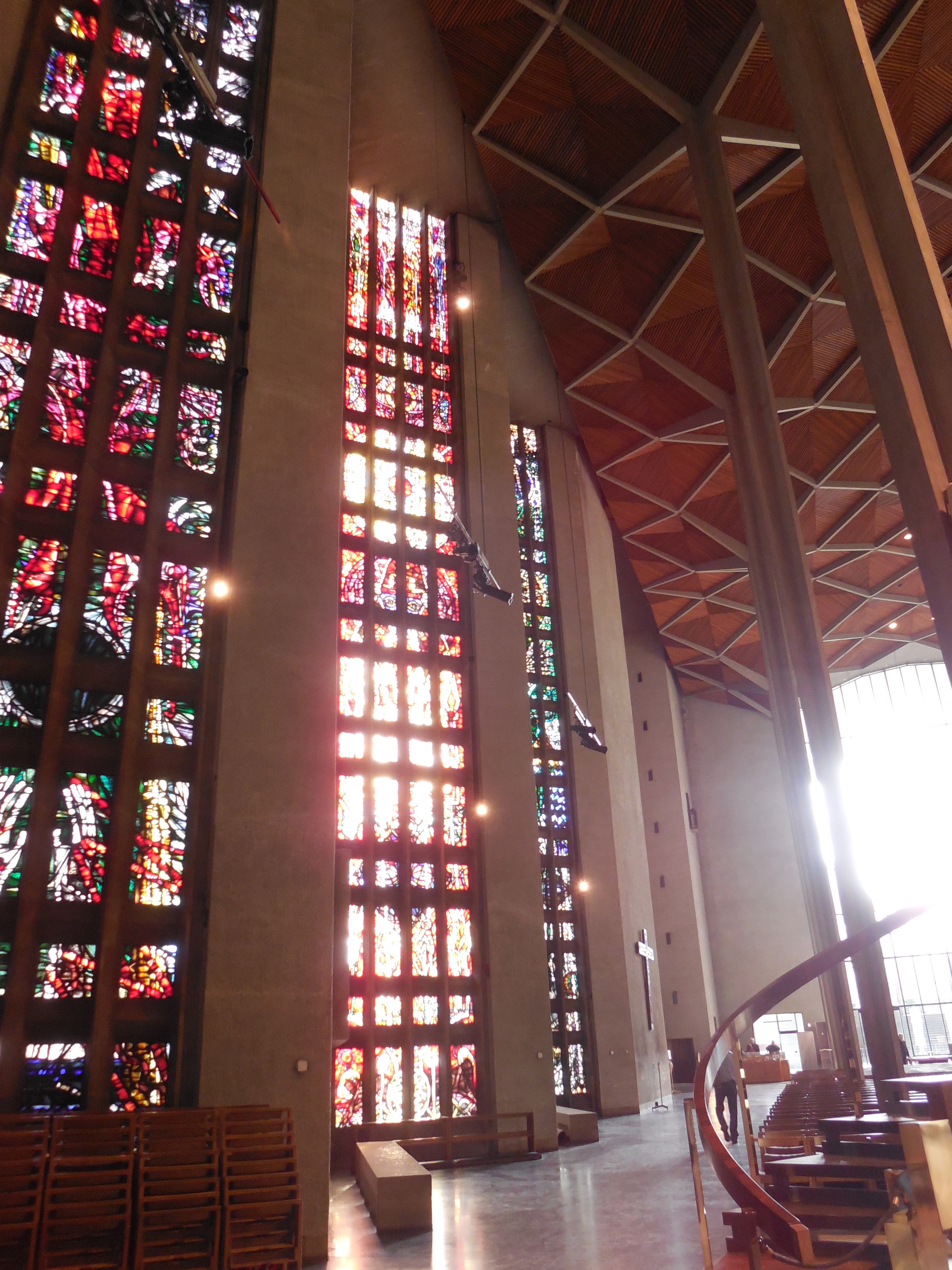
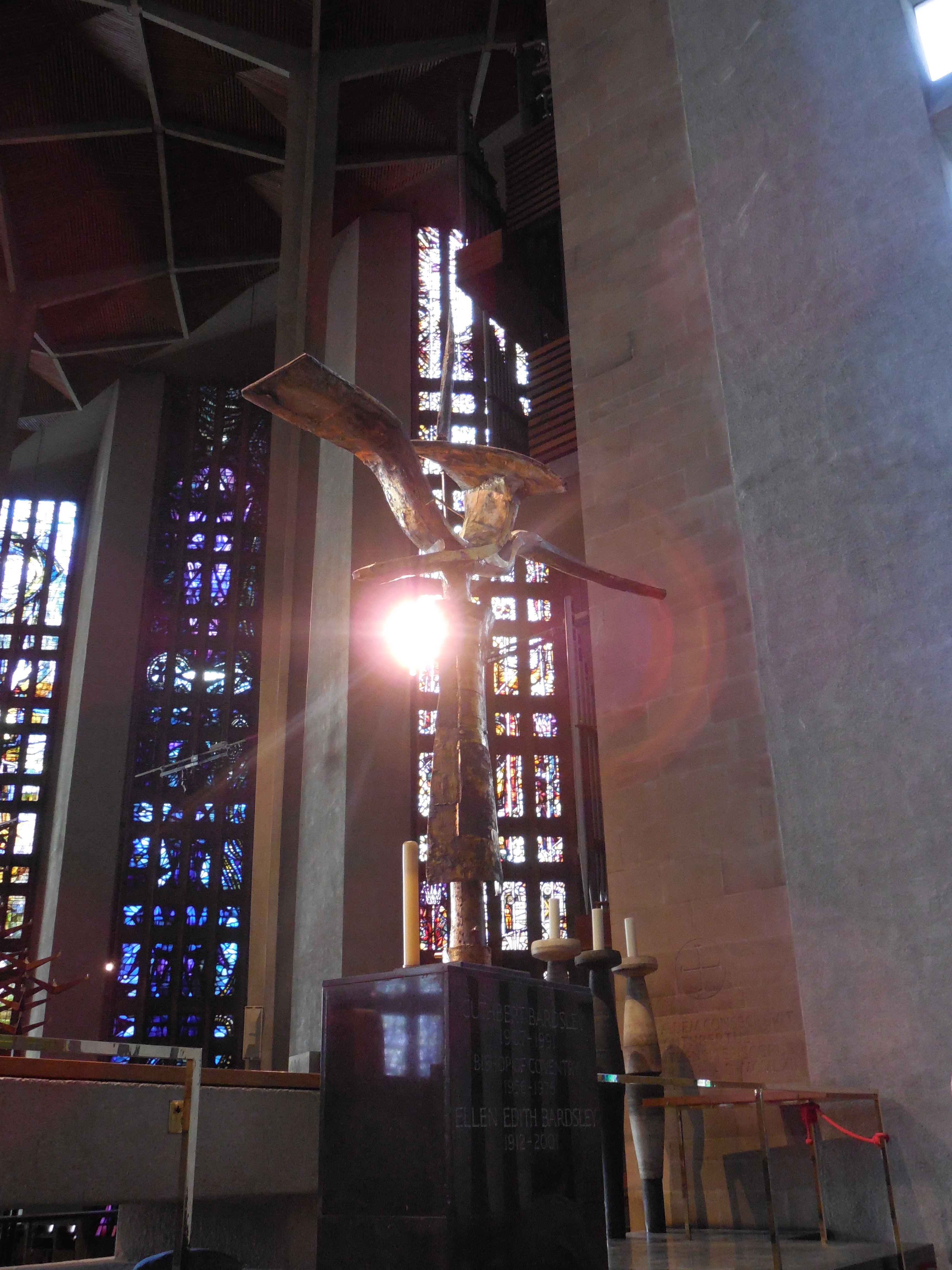
DSCN0301This was taken in Coventry Cathedral up by the altar. That wasn’t our first stop of the day, but I spent a lot more time there than out in the St. Michael ruins. However, the few minutes I spent in the ruins were more moving to me than the hours I spent in the Cathedral.

Here lay the crux of our trip, in Coventry, in the very cathedral where half a century ago Britten’s War Requiem premiered. Everything we’ve been studying converged right here.

DSCN0238In the ruins, there was a bronze cast of Josefina de Vasconcellos’ Reconciliation, which shows a man and a woman embracing. Another bronze cast was placed in Hiroshima, where we sent the first atomic bomb. For years after the end of the war babies were born with birth defect due to the radiation. Civilians there have been directly affected by the war, and it was nice to see that acknowledged, as well (especially since England wasn’t involved with the Pacific theater during WWII).

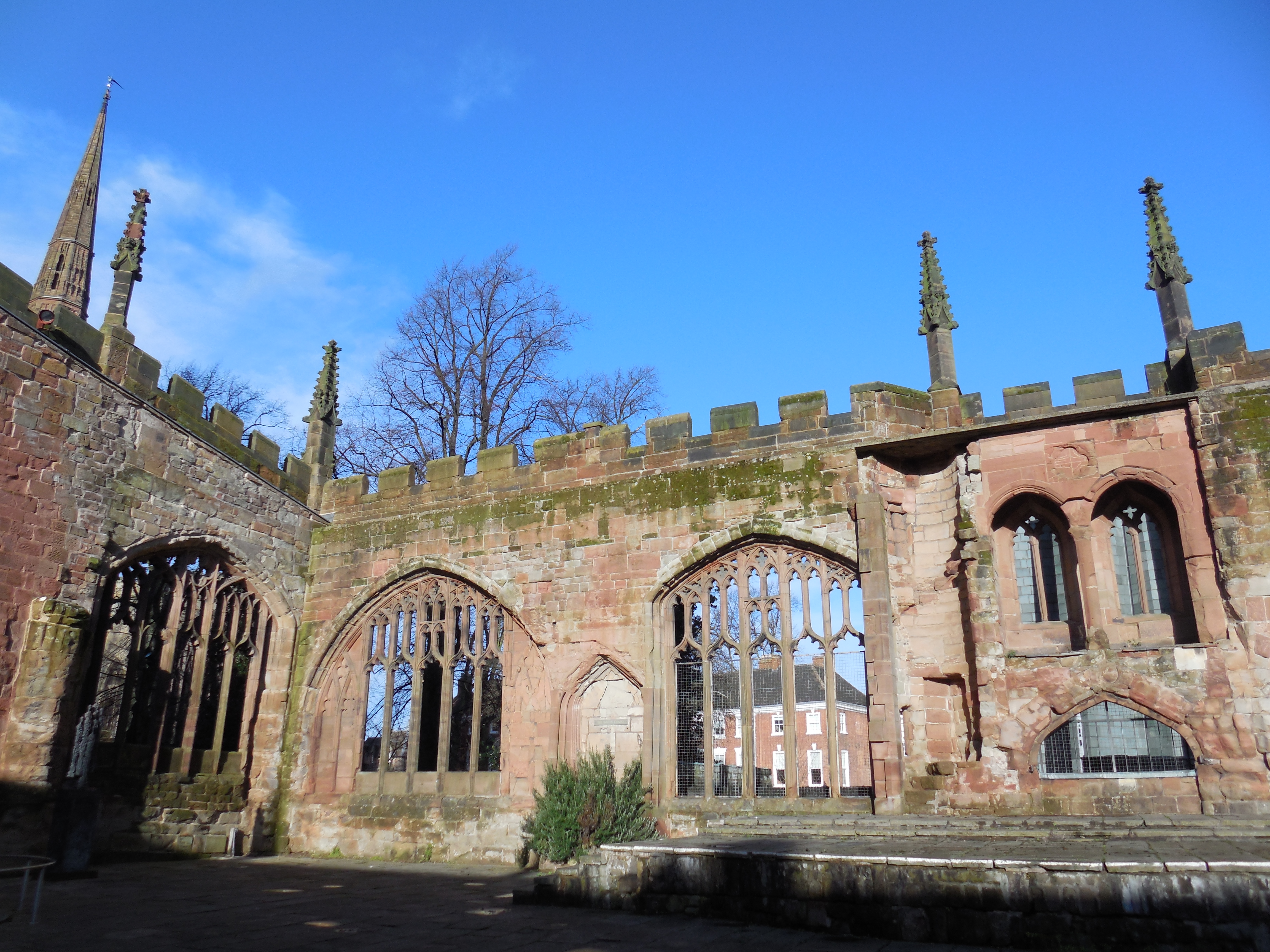
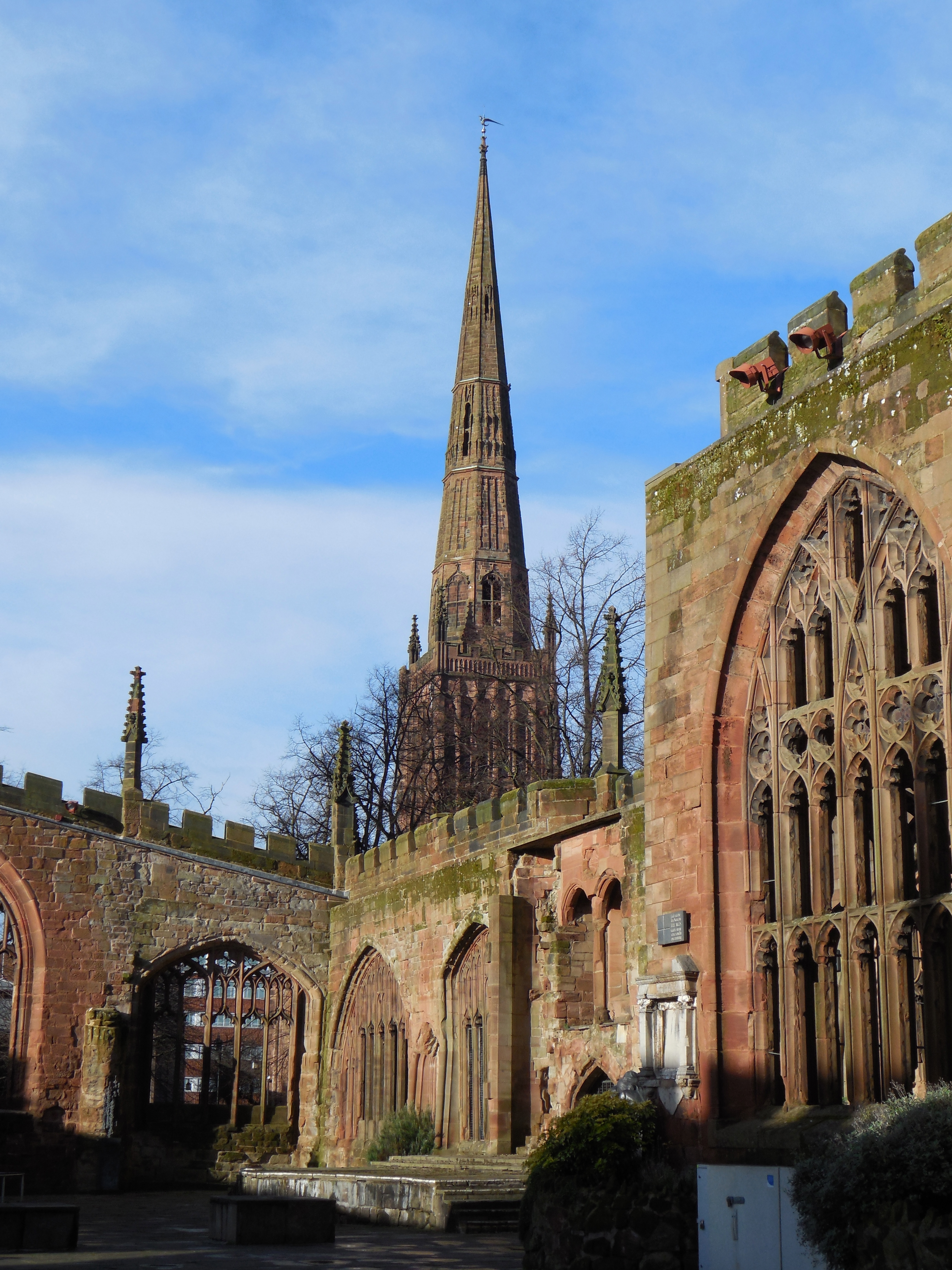
During the Coventry Blitz in 1940, the Luftwaffe (German air force) bombed and destroyed St. Michael’s, Coventry’s centuries-old cathedral (pictured here). This resulted in over one thousand casualties, and what now remains is a symbol for the damage of war and a plea for peace. I think I had expected to be hit with the gravity of this monument right away and noticeably, to feel something of the devastation of war as I always tried to carry with me. But no such feeling came. Instead I snapped pictures for almost the whole time I was out there, without thinking; not until later did I begin to ponder its depth.

DSCN0243

DSCN0256Even then, it was difficult to know how I felt or what I thought. The main image that kept returning wasn’t the sight that lay in front of me, actually… it was the sight of the lonely ruins without the Coventry Cathedral. For over two decades it stood thus, exposed, a testament to the horror of war. I see things in images, though I know not their significances. Reparations take such a long, long time. Germany only just finished paying off its Versailles debt a few years ago. Apparently WWII still had Europe in a daze ten years after the war ended. I’ve read somewhere that colloquially, WWI and WWII are known as “The war before Hitler’s” and “Hitler’s war.” In America, there was a strict divide of “Before the war” and “After the war” for everybody involved in WWII. WWII impacted everybody greatly; that much is apparent. And I guess by sticking with the image of that old cathedral without the new one, I’m wondering just how much of WWII is still unresolved today.

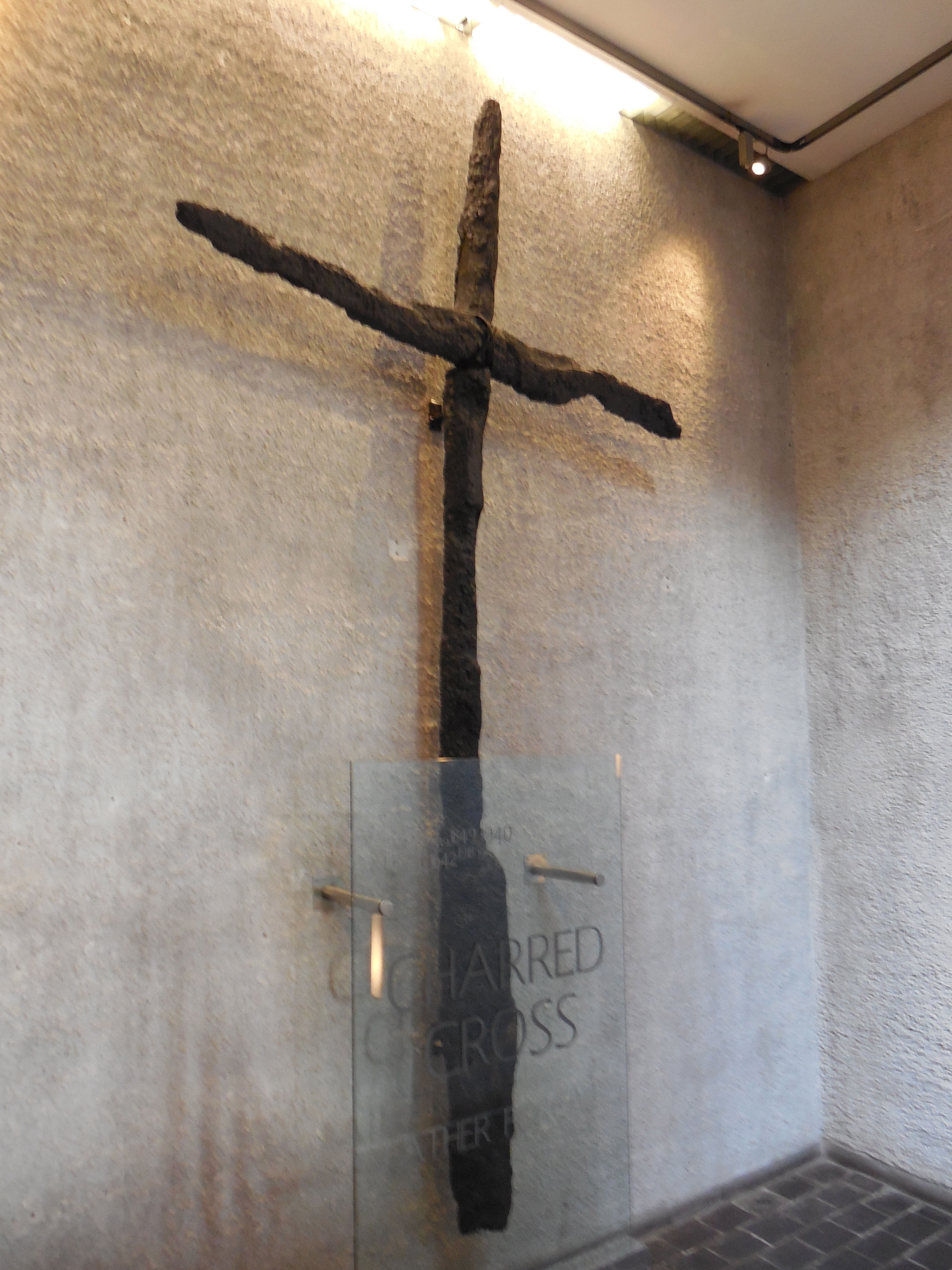
On 15 November, the day after St. Michael’s was destroyed, Jack Forbes saw two pieces of wood shaped like a cross in the rubble. He lashed these together into the Charred Cross, below, which stands in the current Coventry Cathedral on the staircase.

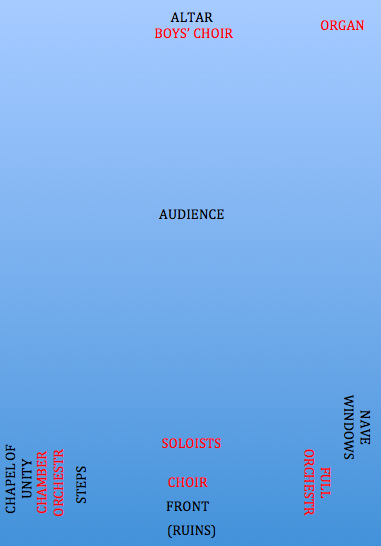
DSCN0308Some years later, Britten was commissioned to write something for the new Coventry Cathedral. In 1962, his War Requiem premiered at the new cathedral. Coventry Cathedral was beautiful, of course, but I wasn’t all that interested in it outside of the War Requiem context. After seeing Evensong in the cathedral, we got to talk to the music director afterward, who told us about his experience conducting the War Requiem and where he would place everybody in the cathedral according to what made the most sense. (He didn’t know the original placement.) The boys’ choir, for example, is symbolically farther away and harder to hear… it says so in the score.

SchematicBased on what he said:

Placing a few of the ensembles near the ruins ensures that the audience will turn around and see them, looking out to the St. Michael’s ruins just outside in the process. As the Requiem illustrates the consequences of war, the ruins would be appropriate. Besides, acoustics are better in this part of the hall.

During the “Libera Me” when the organ finally comes in and everybody plays/sings, the audience is being hit by sound on both sides. Great way to end it all.

Too cool!

Also, here’s some stained glass (because all cathedrals have it).

DSCN0298Speaking of great endings, I had vegan pub grub for dinner!!! What are the chances?!?!?!

Day 6: London and Mahler

At 11 AM today, we stood at the bus stop with all our luggage in tow. The bus arrived—

—and didn’t stop.

Somehow, it missed all fourteen of us.

We managed to procure the services of a shuttle and after that get inside. (Think fourteen people plus luggage in something roughly as big as those smaller buses like the Magic School Bus.) Originally I was next to the door before suitcases were piled up all the way to the ceiling obscuring it. Snug as a bug in a rug, as Andy Hardy would say. We had to hold onto the suitcases, especially at every turn. Besides the Mahler concert, that was the highlight of my day. We made the train with a few minutes to spare.

Later tonight a few of us saw Mahler’s sixth symphony played by the London Philharmonic. During the first half they played a viola concerto by James MacMillan in its world premiere. The piece was cool but a little too busy for my liking… it didn’t really seem organized. Like a true dilettante I thought this piece was the Mahler and that the concert was over. (This might not have happened if I had not quit music school.) In my defense, it’s been a pretty long day.

Clearly I know too little about Mahler to make such an error, but what I have heard of his over the years wasn’t really my bag. Maybe I was dumber in youth. Tonight I really liked a lot of it, some parts more than others… the second movement in particular. I should have been listening more actively so I could provide more intelligent thoughts and musical analysis here, but instead I got off the Tube at la-la land. Of course seeing the London Philharmonic perform is an experience I’ll never forget. I believe it’s the best orchestra I’ve ever heard live. In fact, I just realized that I have a lot of recordings by the London Philharmonic in iTunes, and it’s something about which I really don’t think very often… mostly it’s the composers and the pieces I remember, and then I forget completely about the linking agent between the composer and the the audience—the performer. So much nowadays is about being able to hear pieces on our own time and terms, and performances aren’t important to people anymore because they seem inconvenient. This is a topic with which I’m fairly familiar as we discussed it in my First Year Seminar. Now I see that I haven’t been applying the knowledge as well as I should.

Day 5: Aldeburgh Parish Church, The Maltings, and The Red House

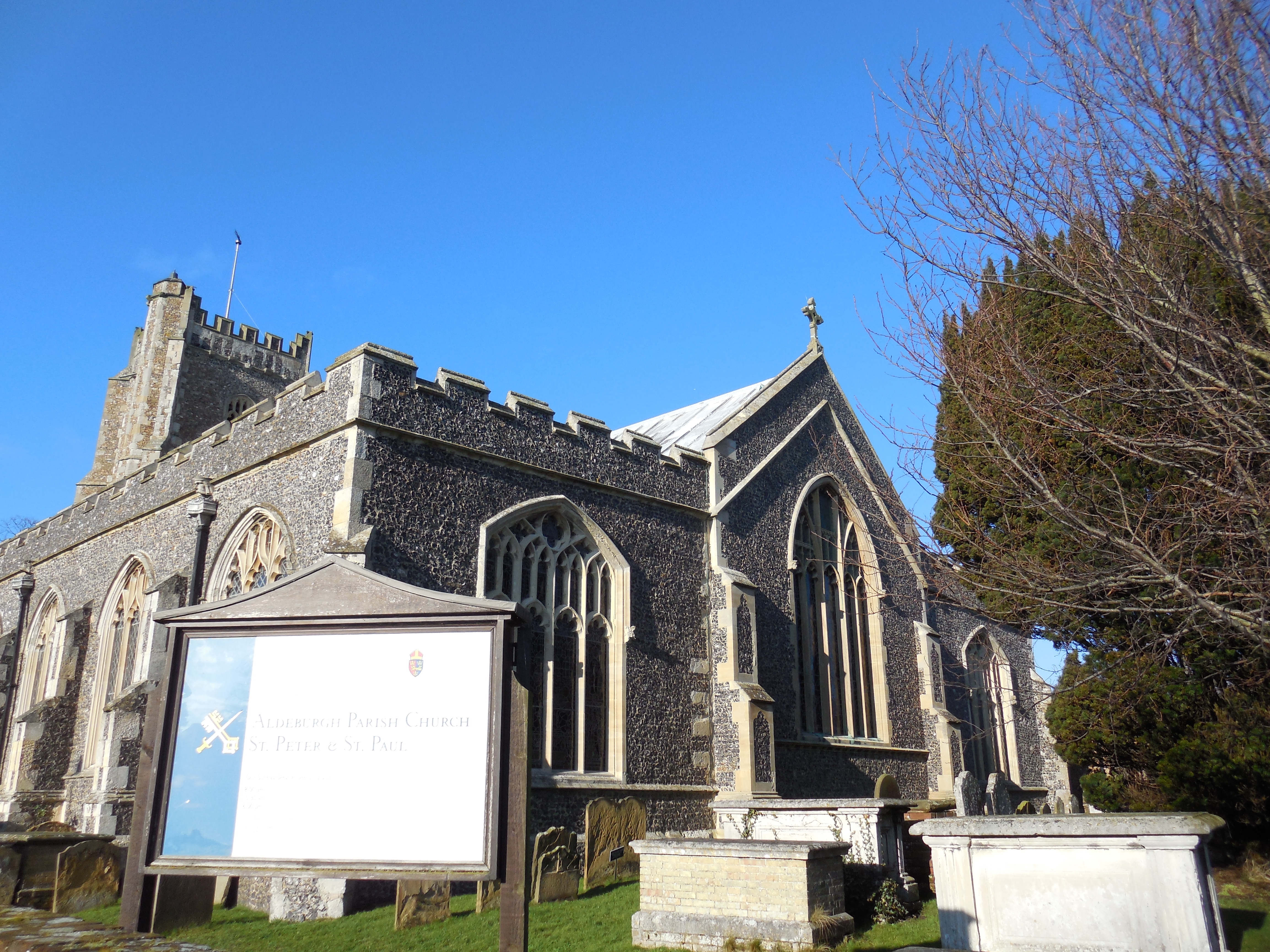
Before heading out to Snape, we looked around the Aldeburgh Parish Church for a bit.

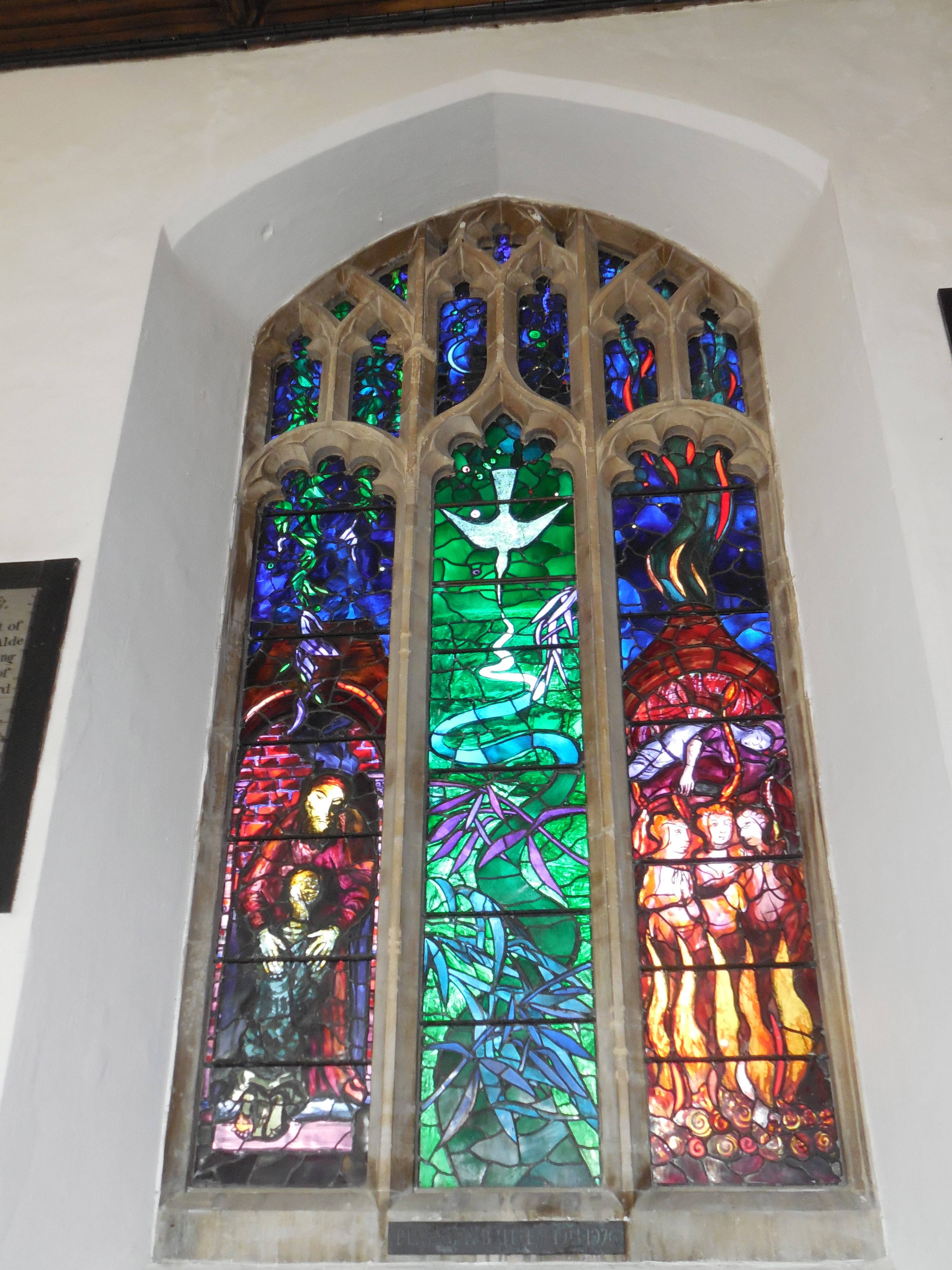
DSCN0194The church commemorates several famous people, including Britten and Pears and poet George Crabbe (from whose work Britten drew inspiration for Peter Grimes) The Britten Memorial Window (below), painted by John Piper, was by far the most vibrant one in the church, bold and innovative where the others are closer to the windows one normally sees in places of worship. Each panel illustrates a piece in Britten’s Church Parables: Curlew River, The Prodigal Son, and The Burning Fiery Furnace.

DSCN0171

After exploring the interior of the church we went out to the graveyard to find the final resting places of Benjamin Britten and Peter Pears. I’ve always felt strangely outside of myself when seeing the graves of those whom I admire. There’s a link between my experiences and theirs as the vessel holding all the years of lives lie at my feet. At no other time do I feel like I know people more than when I see their gravestones, and then I feel both alive and dead simultaneously. With Britten and Pears I thought particularly about the impact each had on the other and wondered how much of Pears was in the notes of the War Requiem and how much of Britten was in Pears’ singing.

Neither grave had an inscription. Subjectively, I was disappointed because I’m rather fond of words… the lovelier, the better. Objectively, what needs to be said? Their best work pleases our ears, not our eyes, and that can’t be replicated on a tombstone.

Curiously, there were stones placed on both graves. This puzzled me at first, since that is a Jewish ritual, and neither Britten nor Pears was Jewish. However, apparently placing stones has spread to other faiths as a sign of respect and god’s love, and it’s seen sometimes on Christian and Muslim.

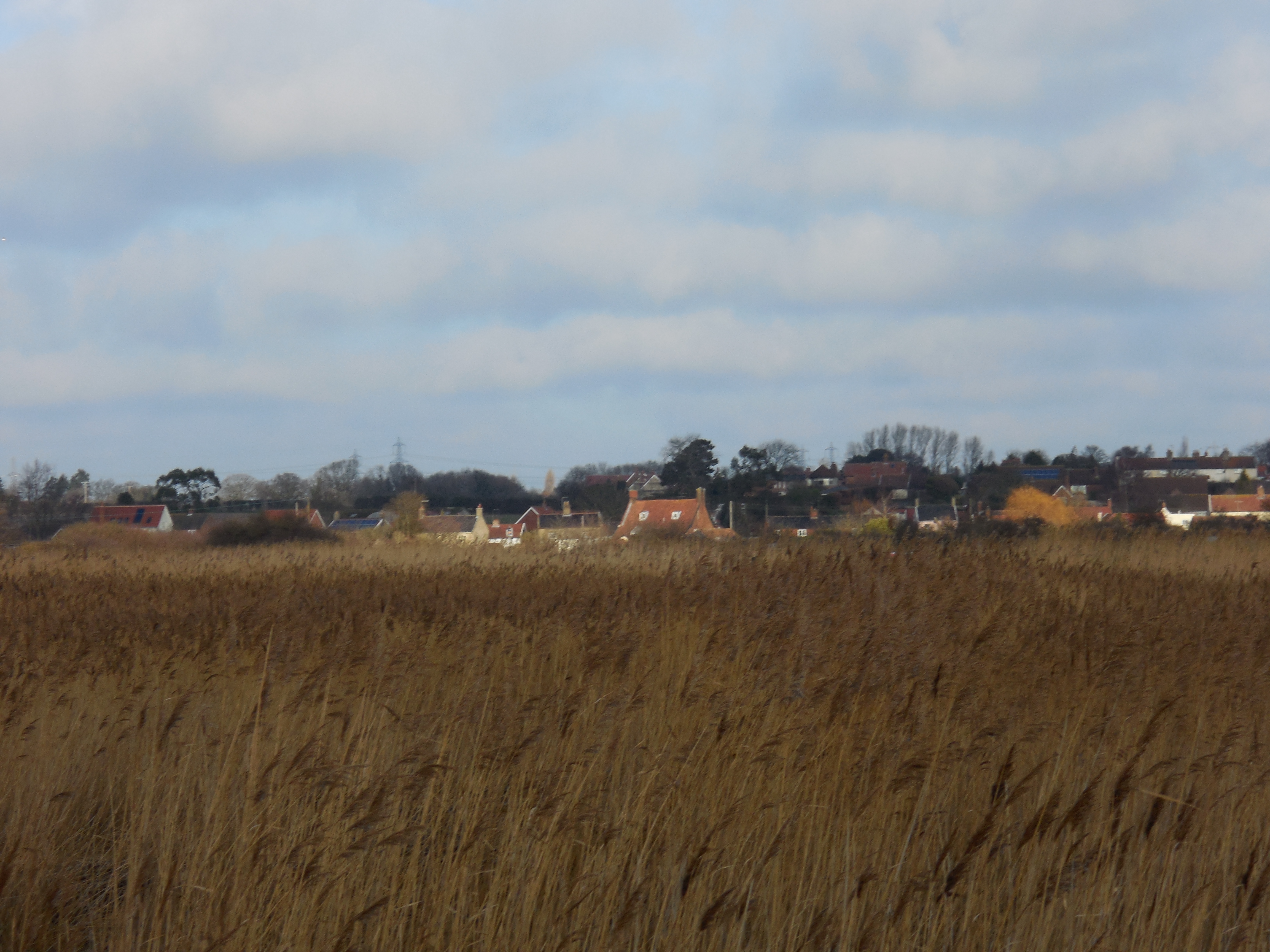
DSCN0188Benjamin Britten wanted to be buried in the reed-banks of Snape, a nearby town where the Aldeburgh Festival is now held (more later on). It isn’t that hard to see why:

DSCN0198But as this was impossible, he was buried in the Parish Church yard, his grave lined with sewed reeds as acknowledgement to his wishes (see Britten-Pears Foundation website for more).

Anyhow, Snape had the same open charm as Aldeburgh although smaller… under 1,000 people live there, while Aldeburgh’s population is approximately 2,700. We took a peek at the Maltings there, but the Concert Hall was closed for repairs. Every June the Aldeburgh Festival is held in Snape.

After that we headed back to Aldeburgh to tour the Red House and Britten-Pears Foundation. First stop was the Archive, where we saw and leafed through preliminary drafts of the War Requiem and Wilfred Owen’s “Anthem for Doomed Youth,” sent to Britten by Owen’s brother, who was very impressed with the Requiem. Unfortunately I can’t share those photos here. I needn’t say that that experience was special; that much is obvious. The handwriting alone reminded me of how much I never knew about Britten and would never know… wissen vs. kennen, if you will. Knowing facts vs. knowing a person familiarly. I can’t think of any other way to put it. Thank goodness for German.

Then we walked over to the Gallery. The Slung Mugs used as an instrument in Noye’s Fludde (Noah’s Flood) were there, as well as the tritone. (Sounded to me like a G-C#; correct me if I’m wrong.) The end of a 1964 performance of the War Requiem was shown as a part of the exhibit there, and as the camera zoomed out I found my thoughts were sluggardly. It might have zoomed out infinitely, as far as my mind was concerned. I find I’m lost at the end of every listening, that my thoughts lag behind the notes not because I’m analyzing it but because I wonder why it should speak to me so deeply. I have never been to war. To me, I suppose, the work is tangible, though I don’t know what it feels like.

After that we visited Britten’s studio. There was a desk, a table, and a piano. Again, no photos allowed. But apparently the sunset was visible to Britten through the window over his desk. Britten only composed during daytime because he didn’t trust his work would be as good at night… and if every day of work ended with that sunset, wow.

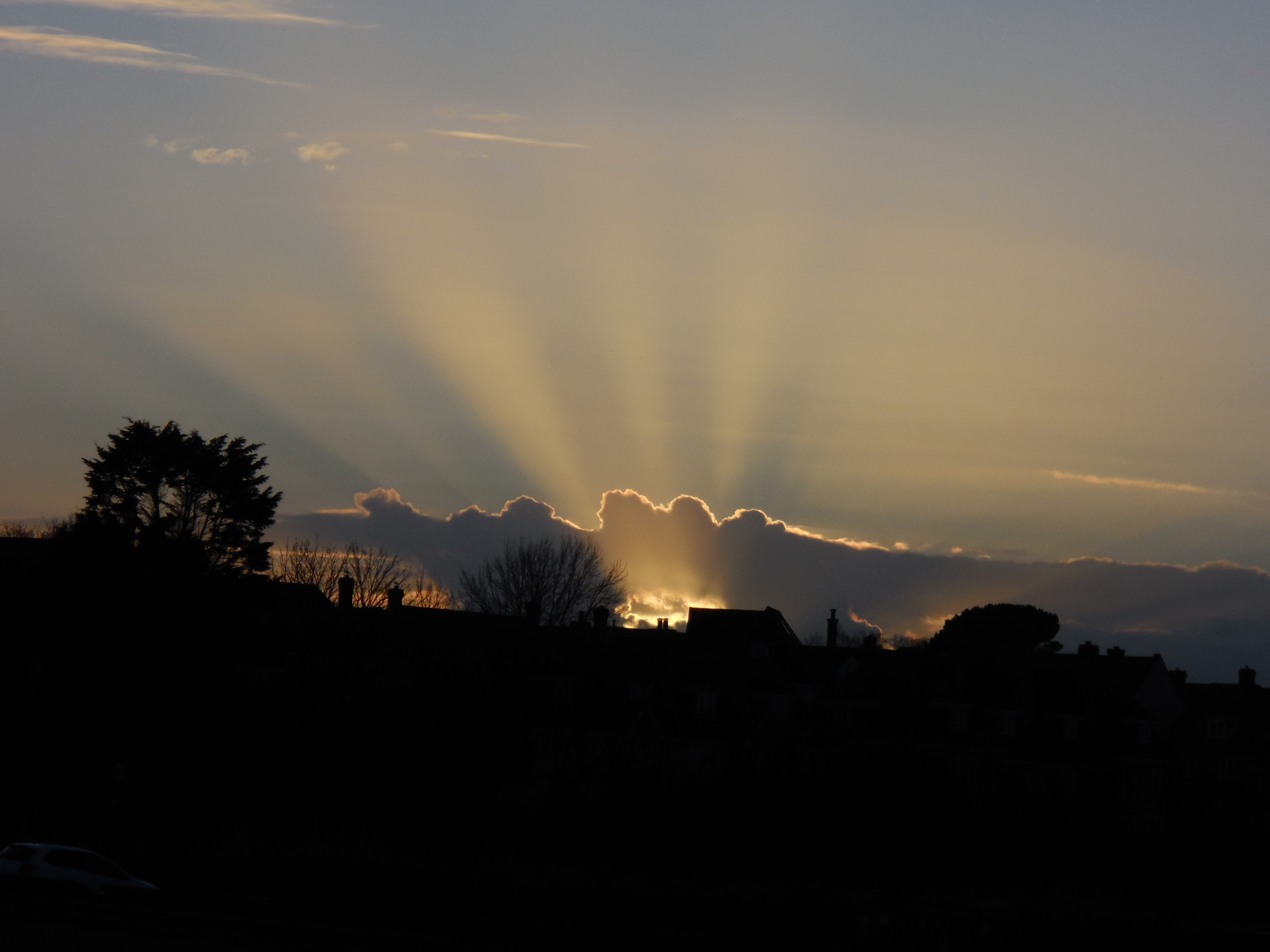
The sun sets a little after four in England, which took a bit of getting used to for me. However, it makes for quite nice ambiance, especially here:

DSCN0223On an arbitrary note: apparently there was a lot of Britten music in Moonrise Kingdom, so I’ll be rewatching that one as soon as I get in the States. That’s a fun film. Everybody should watch it.

Day 4: Aldeburgh

Today we left London and traveled to Aldeburgh, a coastal town known for Benjamin Britten and the Aldeburgh Festival… which is no longer held in Aldeburgh but rather in the nearby town of Snape. (J. K. Rowling’s character was named after this town.)

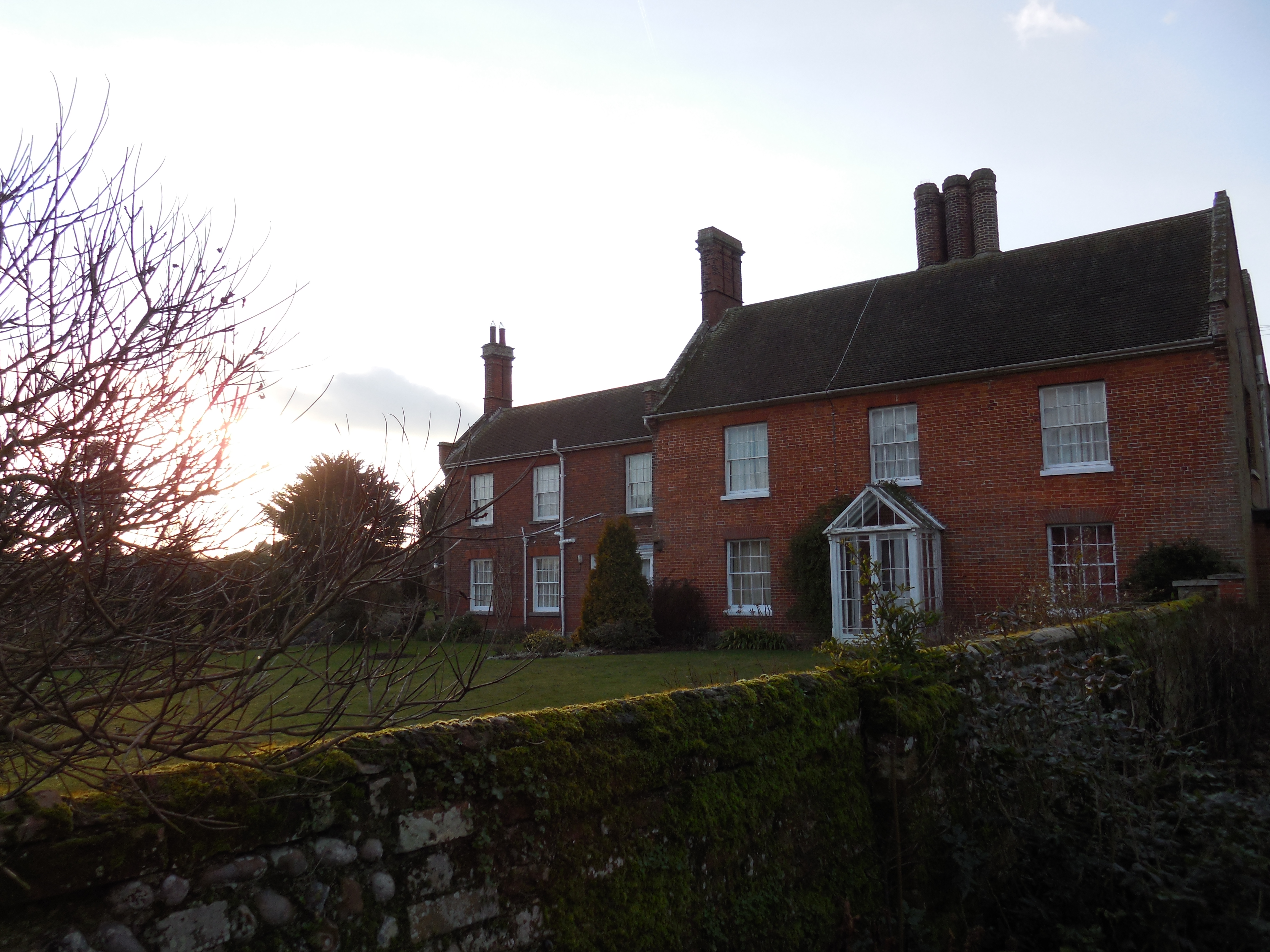
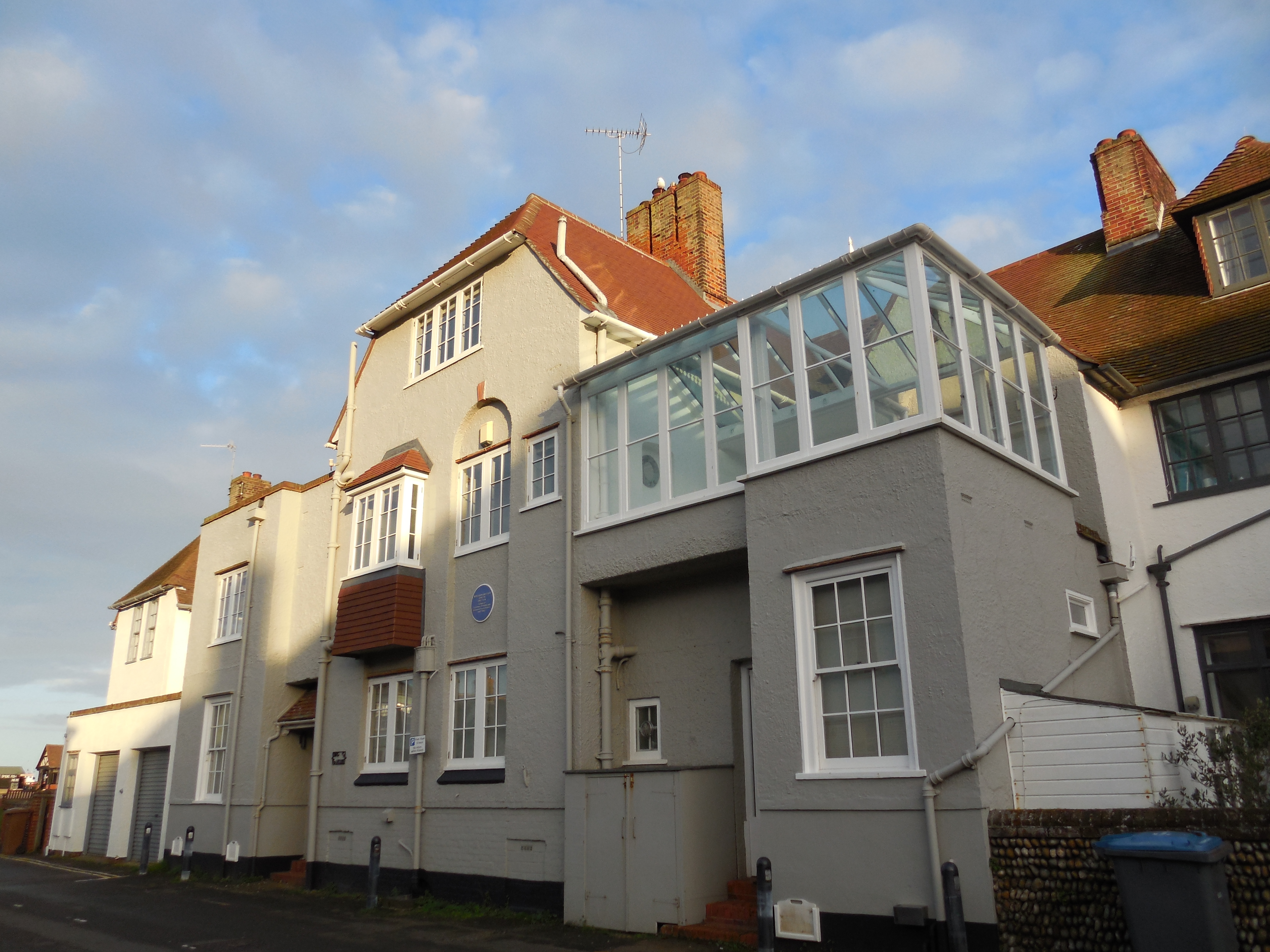
We walked around for a bit and saw Benjamin Britten and Peter Pears’ first home in Aldeburgh, Crag House (pictured below). Their later residence, the Red House, is better known, as the Britten-Pears Foundation resides there.

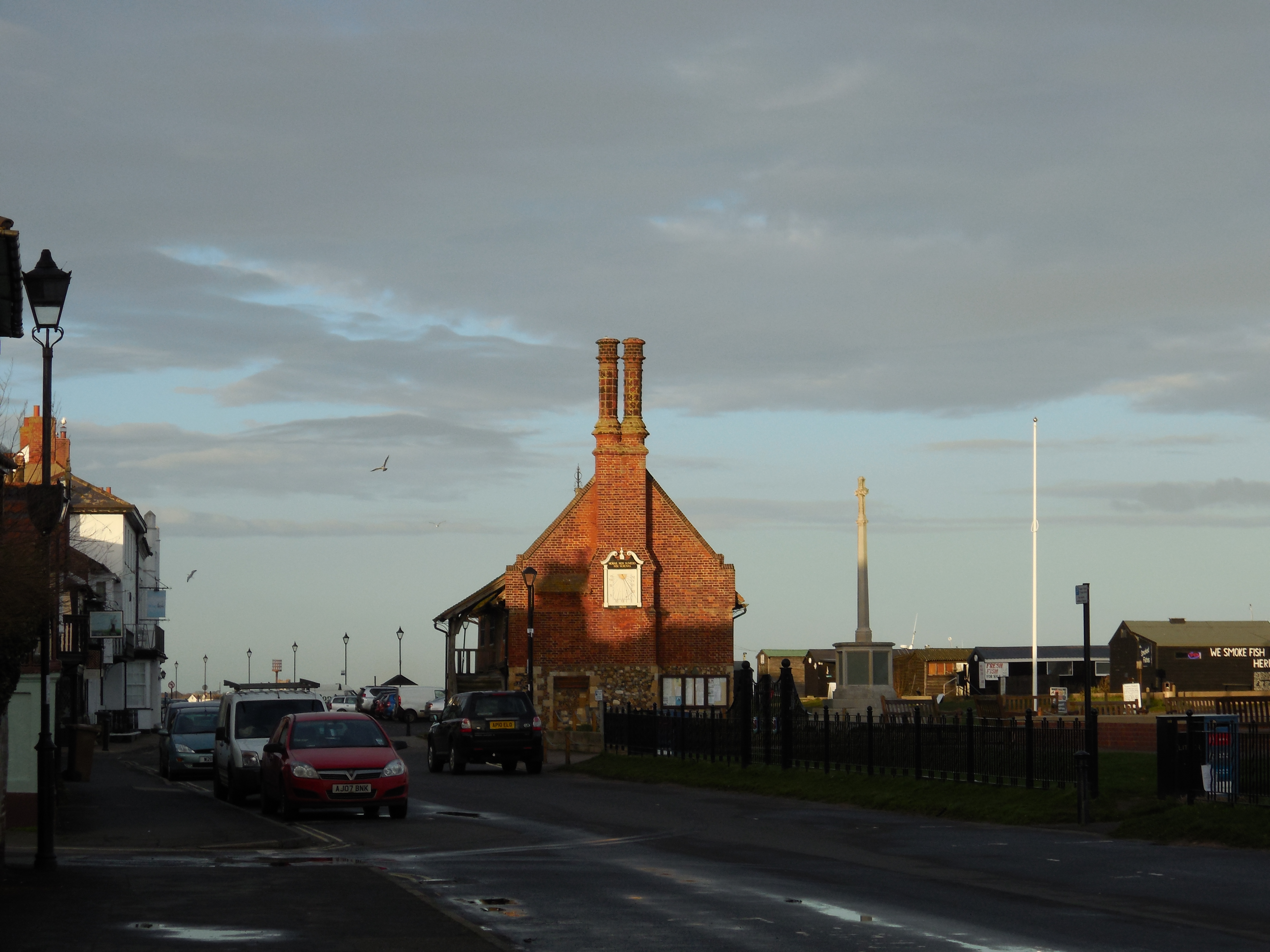
DSCN0140We also saw the Moot House, or meeting house, a building almost five hundred years old. It’s now home to the Aldeburgh Museum although council meetings still take place there.

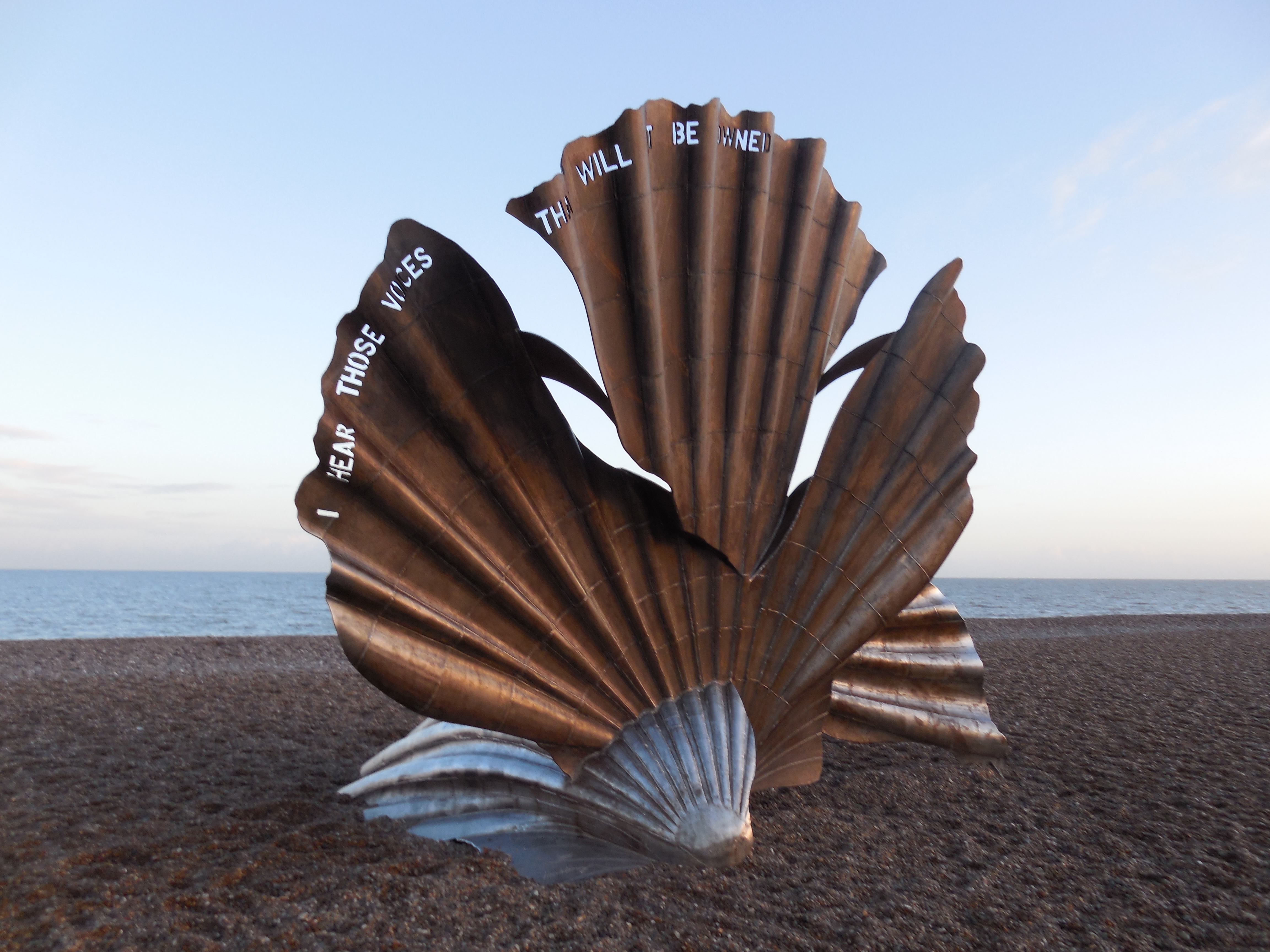
DSCN0142Where there’s water, there’s beach (sometimes), and on the beach lay this very interesting sculpture:

DSCN0161It reads: “I hear those voices that will not be drowned,” from Britten’s opera Peter Grimes. Sculptor Maggi Hambling completed the work for free and then gave it to Aldeburgh. Some regard the Scallop as an eyesore. I rather think it’s poignant, indicative of determination and persistent survival. At one point, Aldeburgh lost over half of its population from storms and other problems (such as illness). Thus the water was formidable to Aldeburgh citizens. Apparently the scallop is a symbol for the St. James pilgrimage, and Hambling wanted that context in the Britten tribute.

Aldeburgh is gorgeous, and the air is pristine (certainly a nice break from the Indiana coal-dust air). In the 19th century physicians loved this place, and it became a popular vacation spot. There’s so much space and so much coastline, indicative of what lies beyond, so much to fill with words and notes and paintstrokes, and I feel very at home here.

DSCN0123DSCN0169

Day 3: Blogger’s Choice (Globe Theatre and British Library)

There were no group activities scheduled for today, so I slept in a little (yay!) and visited Shakespeare’s Globe and the British Library.

450 years have passed since the world gave us Shakespeare. Because of this, there will be a year-long celebration… with most of the activities beginning in March or April. (He was born in April.) It would have been criminal not to visit the Globe while I’m here. I got to the Globe just after 12:30 and signed up for the next tour at 1, which gave me thirty minutes in the exhibit. Suggestion for anybody planning on going: half an hour is not long enough to get the full experience there. More like an hour or hour and a half.

University in Shakespeare’s time apparently didn’t accept married men, so he didn’t get to go. Too bad he knocked up Anne Hathaway (not the actress) and had to marry her. So instead of going to school he wrote beautiful poetry and plays and is remembered to this day. Take that, University. Most people in London hated theater, so actors headed to the south side of the Thames to make a theater district outside of the city. (16th-century London only existed north of the Thames. Since then it’s expanded a little.)

Outside of the theater there were names of donors on the ground—including Laurence Olivier and Vivien Leigh. That was quite wonderful. This is the third Globe Theatre—the first burnt down early on and was promptly rebuilt, while the second fell into disrepair after Shakespeare’s death and eventually was demolished. This new Globe is less than two decades old, but the period detail is spot-on.

Back in the day, tickets cost a penny for standing room in the front. This area was for poor people, referred to not-so-affectionately as “penny-stinkers” because they didn’t bathe. (But apparently Queen Elizabeth got away with bathing once a month.) Bench seats cost tuppence, chair seats cost threepence, and the seats behind the stage cost sixpence and were reserved for nobles whose fineries could be enjoyed by commoners along with the play. Now the sixpence seats are used for musicians, as there is always live music for Globe Theatre productions.

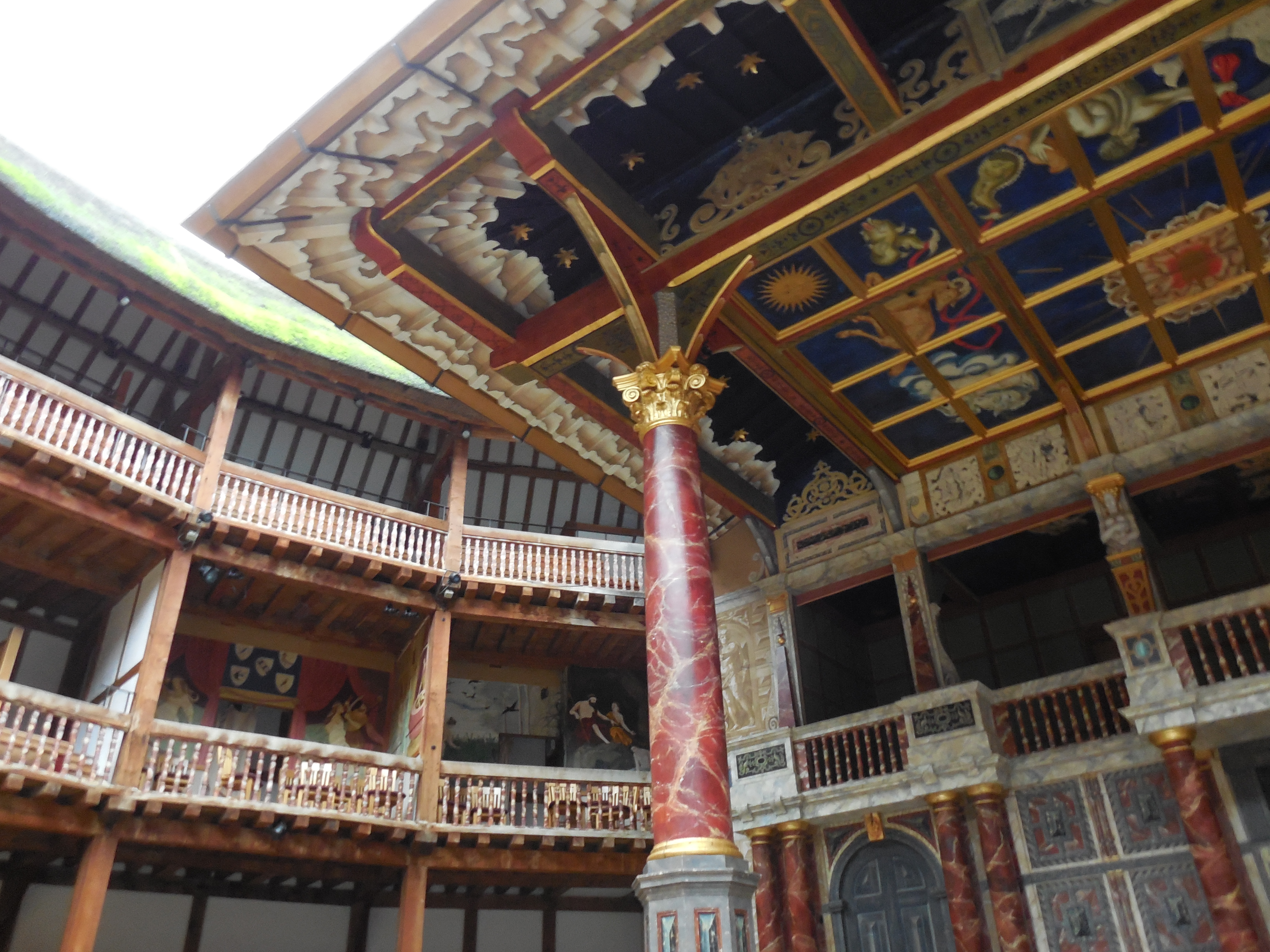
DSCN0096

There’s some interesting detail in the ceiling, which depicts the heavens with a sun in the middle. The sun is actually a trapdoor from which “gods” can descend to the stage. Alternately, visitors from hell pop up from the trapdoor on the stage. Ghosts in Shakespeare’s plays, such as Hamlet’s deceased father, made their entrances this way. So ghosts are supposedly from hell or purgatory or something. Guess this is the standard interpretation.

There’s just something about stepping back so wholly in time. I can’t really place a finger on it, and the experience isn’t complete until I see a play there. Perhaps when it’s a little warmer. Better not to have excitement dampened by a runny nose.

At the British Library I really lucked out, since there was a tour at three and I got there in time to get in on it. The tour was well worth it; I walked out knowing a lot about the library’s storing, protection, and access of materials along with other general information that I wouldn’t have known from just going there. All books published in the U.K. have to come to the Library by law. There are over 200 million items and four basements for storage. Additional items go to the Library’s other building in Yorkshire.

Many academics come there to research. Materials in the library are only available to those with Reading Passes, which can be procured by showing documentation and providing information about research people would plan on doing there. Reading Passes are available to people whether or not they live in the U.K., and they’re free of charge.

Non-fragile materials are moved on a conveyor belt and delivered to the reading rooms from which researchers can make requests. Fragile materials are delivered by hand. All in all, the British Library seems to have efficiency down.

And of course no visit to the British Library is complete without the Treasures Gallery. Seeing the Magna Carta… holy crap. 800 years of history seen by myriad people of many generations. (I’m exaggerating, maybe, but I really don’t care.) How is it possible to keep 13th-century paper from rotting? Pretty much everything in Illustrated Manuscripts: Europe looked like the Grail Book from Indiana Jones and the Last Crusade… not the Grail Diary that Indy’s dad had, but the illustrated book with the three knights of the First Crusade that Donovan showed Indy at the beginning of the movie. It only got better from there: Mendelssohn’s Wedding March manuscript, Beethoven’s tuning fork (!!) and Violin Sonata in G Major, an 11th-century copy of Beowulf, a letter from Winston Churchill regarding United Nations on September 1, 1944 (five years to the day Germany invaded Poland), “Yesterday” Paul scrawl in the Beatles exhibit, and W. H. Auden’s 1939 notebook. The plaque’s last sentence read: “Auden writes too about meeting Benjamin Britten and Peter Pears who were also living in New York in 1939.”

Now I really can’t wait for Aldeburgh.

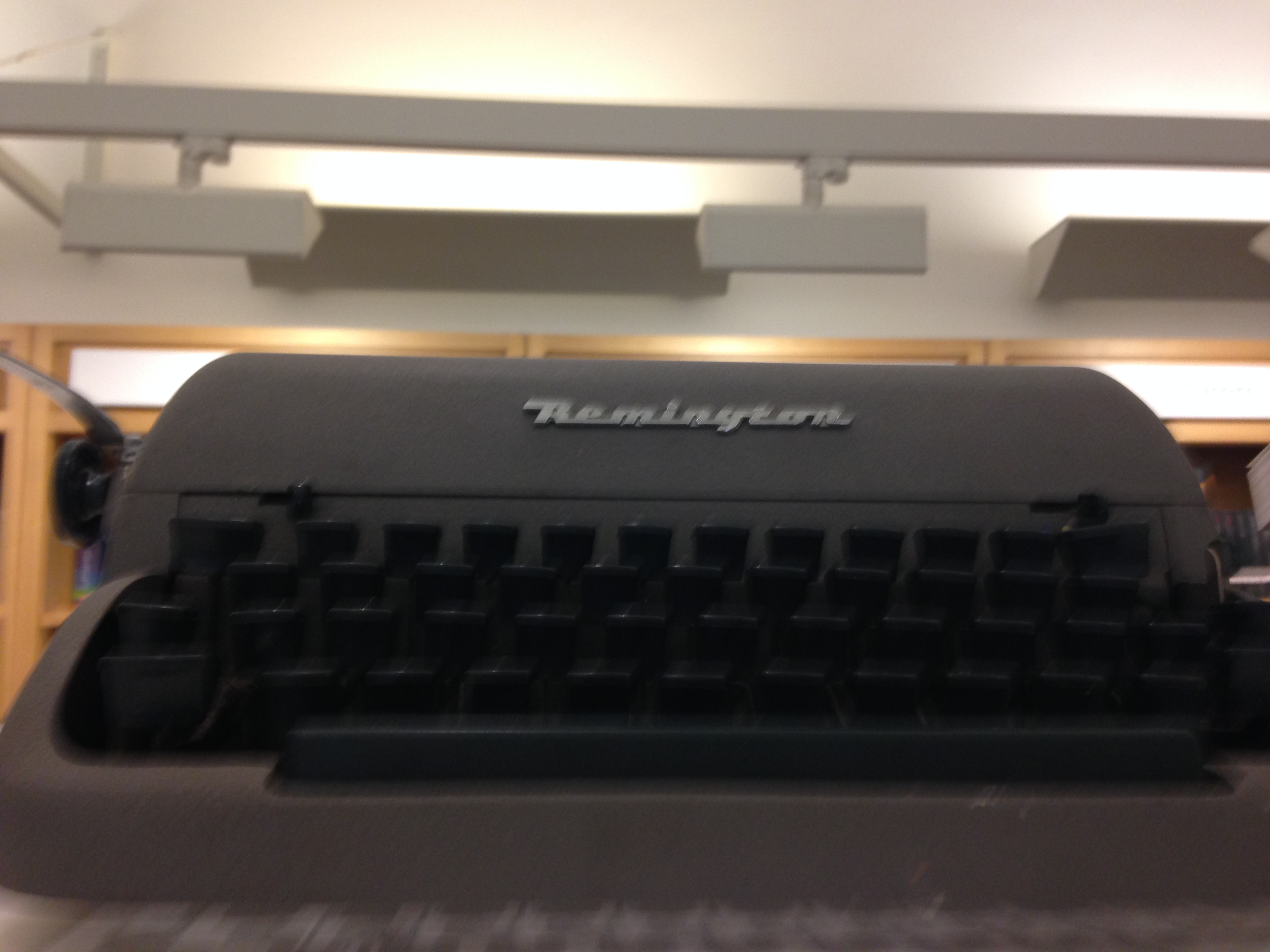
In other news: apparently things need not be living to be able to move. My typewriter followed me here.

                           Dorm                                          British Library Gift Shop

1014212_10201830226141833_899237620_nIMG_0001

Day 2: All Over The Map

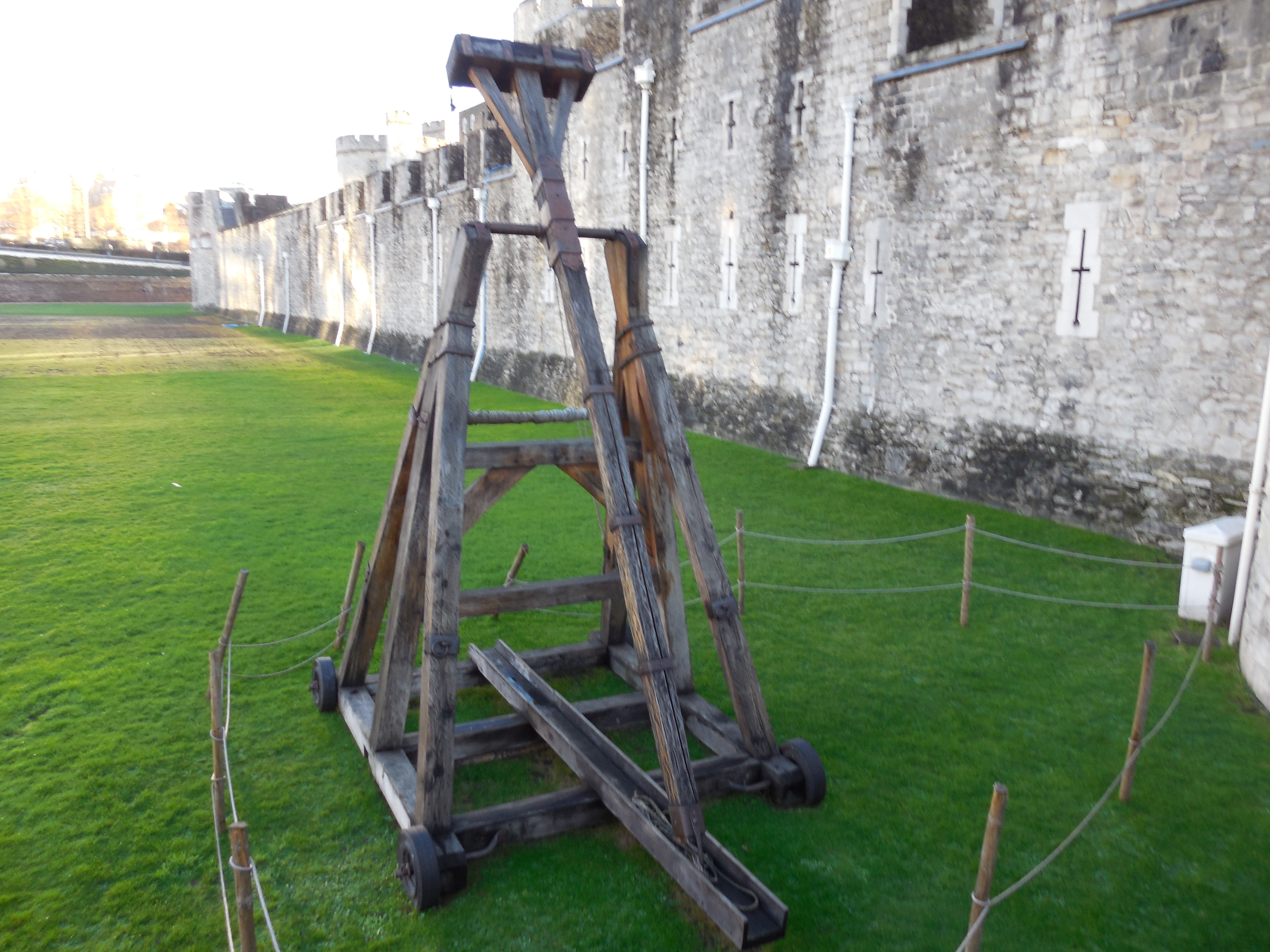
Today there was a lot lined up, which made things spontaneous and fun. We started off this morning early at the Tower of London, and saw, among other things, this trebuchet.

DSCN0031Also on display were various torture devices, including manacles and the infamous rack, historical weapons, and Royal Mint coins and coin presses. Interestingly, pounds sterling were said to have originated with the coinage of William the Conqueror where it was used for reliability reasons. I also learned that King George VI had a sword… maybe he should have hopped over to Germany and decapitated Hitler with it.

Delaroche’s The Execution of Lady Jane Grey in the National Gallery made an appearance on one of the information boards. (Also known as the Nine Years’ Queen, Lady Jane Grey was convicted of treason and executed in favor of bringing another queen to the throne. Ironically, Grey’s successor, “Bloody Mary” I, ended up screwing England over by trying to switch it back to Catholicism and killing a lot of Protestants in the process.)

St. John’s Chapel had to be my favorite because it had that neat old air and look about it—no wonder, being from the 11th century. Apparently it’s London’s oldest church. It’s silly, but I find myself fascinated by how vastly different old is from new. Before studying the evolution of style—architecture in this specific instance—stuff like St. John’s Chapel just seems to be from a completely different world. Too bad we couldn’t take pictures; otherwise it’d be on here.

Oh, and we also saw the Crown Jewels. I definitely had mixed feelings about that. It seemed too opulent, though nowhere near as bad as the Vatican—saw it in 2006. (As comedienne Sarah Silverman once said, “Sell the Vatican, save the world.”) In 2011 I had gotten quite a different vibe from Buckingham Palace: it was quite tastefully decorated, nothing really done to excess. (Following Aristotle’s Doctrine of the Mean, falls on the mean of magnificence rather than the excessive vice of ostentatiousness or deficient vice of stinginess, is the best way I can describe it for you other philosophers out there.) Now to ensure that the Jewels don’t ruin Buckingham Palace for me, which probably won’t happen… although I can’t deny that my comfort level went way up after leaving that particular exhibit.

Next was St. Paul’s Cathedral (cue “Feed the Birds”). The religiosity there wasn’t very interesting in itself, but it did play a big role in early music development from what I understand. In the twelfth century St. Paul’s educated boy choristers and pushed the boundaries of church music in the process, exploring expression of faith.

From St. Paul’s Golden Gallery, 528 steps and 85 meters (approximately 279 feet) from the main floor of the cathedral, the view was spectacular. Nearly asphyxiating from the climb was worth it. We got there before the sun passed behind the clouds, and the air and slight breeze felt nice.

DSCN0081At around three we headed to Westminster Abbey, which closed for visitors at 1:30. We got to go in anyway because there was a service (yay). I don’t know my sects very well—or the religions themselves for that matter—but it was Anglican. Before this I hadn’t been a service for probably around ten years, so I had no idea what was going on, but it was interesting. In any case I walked over Charles Darwin and Ralph Vaughan Williams, among others.

Betjeman’s “In Westminster Abbey” is one of my favorite poems, and I thought about it a little today. Written early during World War II, it satirizes framing war through religion and seems to pick up where World War I left off—at the doubting left by all affected parties who thought that god would help them win, at the deep reluctance to fight a war ever again. The tone seemed acerbic, but it rang very true. It’s even somewhat relevant to the course—certainly the War Requiem noted the ties between religion and war, though a commentary on those ties isn’t as visible in the work.

Our last stop (and my favorite) was the Churchill War Rooms. I remembered my fondness of the place from an earlier trip to London. It’s definitely a more hands-on approach than most museums, allowing us to immerse ourselves by providing the original structure and leaving details almost completely unchanged from the 1940’s. Studying World War II has been an interest of mine for a really long time, and in the War Rooms I always feel like a kid in a candy store. Last year, when visiting the Roman ruins at Volubilis in Morocco, I found the civilization rebuilding itself before my eyes, aided by the perfect light provided by dusk and the nests where shadows fell. For the shadows were tall, as the buildings must have been. It took only a little bit of imagination. In the Churchill War Rooms, it takes none. It’s all right there.

In 2011 I bought the Ration Fudge in the gift shop there. Now I’m vegan. But I did manage to find a (vegan) chocolate cigar instead, and that will be quite the adventure.

Day 1: Trafalgar Square, National Gallery, and St. Martin-in-the-Fields

At approximately 2:51 AM Eastern Time (7:51 London Time) aboard the plane: listening to Nat King Cole’s L-O-V-E on repeat. So tired that my mind is lagging in the key change, and the first part of the song sounds W-R-O-N-G.

Fifteen hours or so afterward, I’m more cogent, but not much. Exhaustive euphoria (after I turned off the song and forgot about key changes) helped with the airport shuffle, and now I find I’m not tired at all.

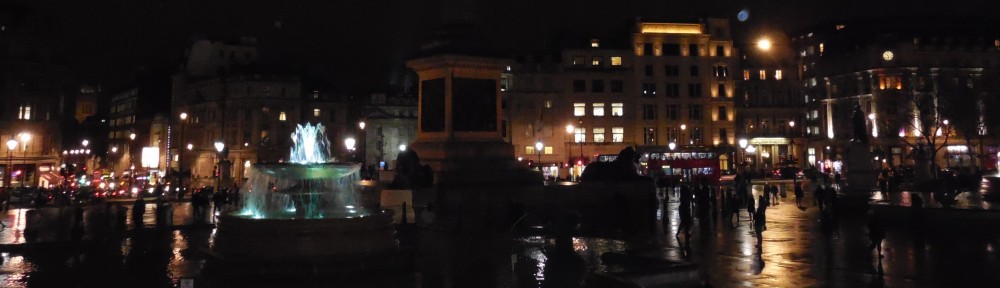
After eating, some of us headed to Trafalgar Square and the National Gallery. There was only an hour before the concert at St. Martin-in-the-Fields began, but from rushing through the exhibit I still saw artwork ranging from the 15th to 18th centuries (and surely I’d had seen a wider range if there weren’t time constraints) and from varying European nationalities… a single room was comprised nearly wholly of Monet pieces. Perhaps my favorite was Hogarth’s whimsical Marriage à la Mode series which depicted, from what I recall, married life in upper-class families. Each painting caught my attention. Some were interesting, and most were breathtaking not only in the lifelike detail of the subjects but also in the way they captured the emotions of the subjects. However, what most captivated me was the ambiance of the place, the echoes of footsteps that indicated not only tall halls but, with a little imagination behind closed eyelids, past and present time compressed in agelessness. And sitting there I felt creativity seize me, that from the momentum of all these greater others I could find it in myself to find my voice and craft something uniquely powerful. If only.

Fauré Requiem by Candlelight didn’t come until the second half of the concert, but I enjoyed the first half as much. Throughout the choir, St. Martin’s Voices, had a great sound and blend, and the baritone soloist, James Newby, carried well, had impeccable diction and an exquisite tone. In fact, the choir was completely intelligible, as well—yay. Hearing Vaughan-Williams’ Five Mystical Songs brought me back to singing that piece in WYHC at Interlochen. The Requiem was a treat to listen to, also… right away I noticed the chant-like beginning was similar to Verdi’s Requiem and Britten’s War Requiem, and we listen to those in class (or at least portions of the first). I’m sure that there are other similarities I’m missing and many things I’m missing due to general exhaustion.

Zzzzzzzzzzzzzzzzzzzzzzzzzzzzzzzzzzzz